
Accumulation Schedule
| Year | Addition | Return | Ending balance |
|---|
Estimates only, based on steady additions and a constant growth rate. Actual investment or annuity returns vary and are not guaranteed. Not financial advice.
What is a Annuity Calculator
An Annuity Calculator is a useful financial tool for estimating how much an annuity may grow or how much income it could provide over time. Annuities are commonly used in retirement planning because they can turn a lump sum or regular contributions into a predictable stream of payments. By entering the investment amount, interest rate, payment frequency, and time period, you can estimate potential future value or income without performing complicated calculations manually.
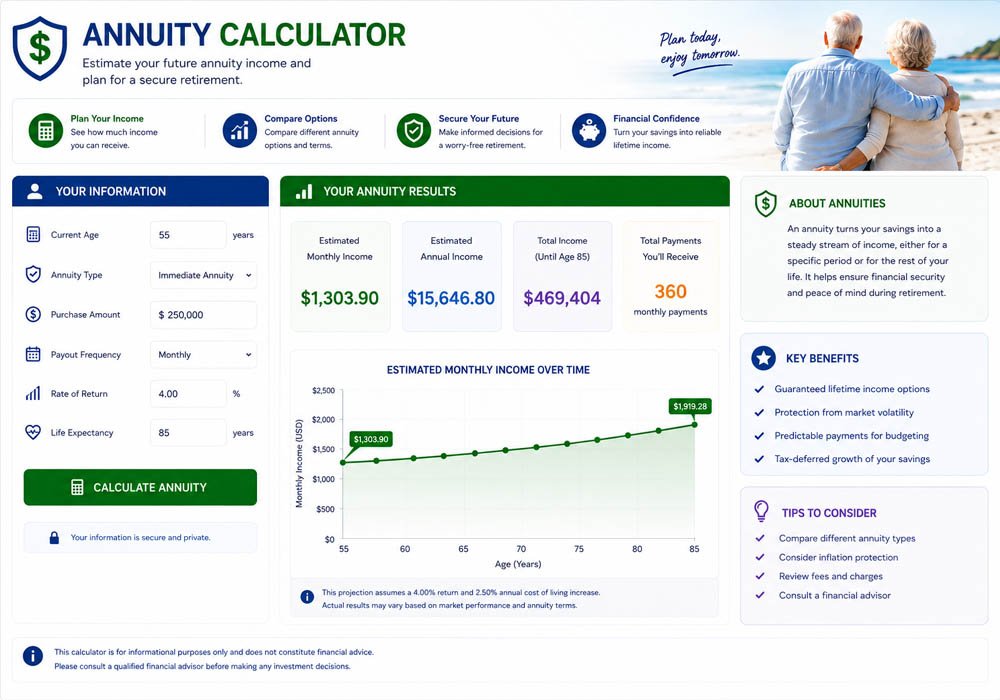
An annuity payout calculator can be especially helpful when comparing different retirement scenarios. You may want to estimate how much a $100,000, $250,000, $300,000, or $1,000,000 annuity could potentially provide each month. The actual payout is not determined by the investment amount alone. Age, annuity type, payout period, interest rates, fees, guarantees, and payment options can all affect the final amount.
How Does an Annuity Calculator Work?
An annuity is generally a financial contract in which money is exchanged for future payments. Depending on the type of annuity, you may invest a lump sum, make regular contributions, or allow money to accumulate before beginning withdrawals. The payments can be structured for a specific number of years or, with certain products, for the rest of your life.
An annuity calculator uses the information you provide to estimate the potential value or payment amount. For example, if you are planning for retirement, you could enter your initial investment, expected interest rate, number of years, and payment frequency. The calculator can then show how much the money may grow or how a particular amount could potentially be distributed over time.
A fixed annuity calculator can be useful when you want to estimate growth based on a stated interest rate. An immediate annuity calculator is more suitable for estimating income when a lump sum is converted into payments that begin relatively soon. A lifetime annuity calculator focuses on income that may continue for the rest of the annuitant’s life.
The results should be considered estimates rather than guaranteed quotes. Actual annuity contracts can include fees, surrender charges, death benefits, survivor options, guarantees, and other conditions. These features can change the amount of income you ultimately receive.
Annuity Payouts and Retirement Income
An annuity can provide regular payments that supplement Social Security, pensions, or other retirement income, making it easier to manage monthly expenses.
A monthly income annuity calculator estimates how a lump sum could potentially be converted into regular payments based on age, payout options, and contract terms.
Some of the main factors that can affect an annuity calculation include:
- Initial investment: The amount used to purchase or fund the annuity.
- Interest rate: The rate used to estimate accumulation or growth.
- Payment frequency: Payments may be monthly, quarterly, or annually.
- Payout period: The number of years or lifetime over which payments are made.
- Age: Age can be particularly important for lifetime income calculations.
- Annuity type: Fixed, immediate, deferred, and lifetime annuities have different structures.
- Fees: Contract fees and other charges can affect the available value or income.
- Guarantees: Survivor benefits and other guarantees may change the payment amount.
- Inflation: Fixed payments may lose purchasing power as prices increase.
These factors explain why two people investing the same amount can receive different annuity payments. A best monthly annuity calculator can help compare different assumptions, but the calculator result should not be treated as an official insurance-company quote.
Annuity Calculator Formula
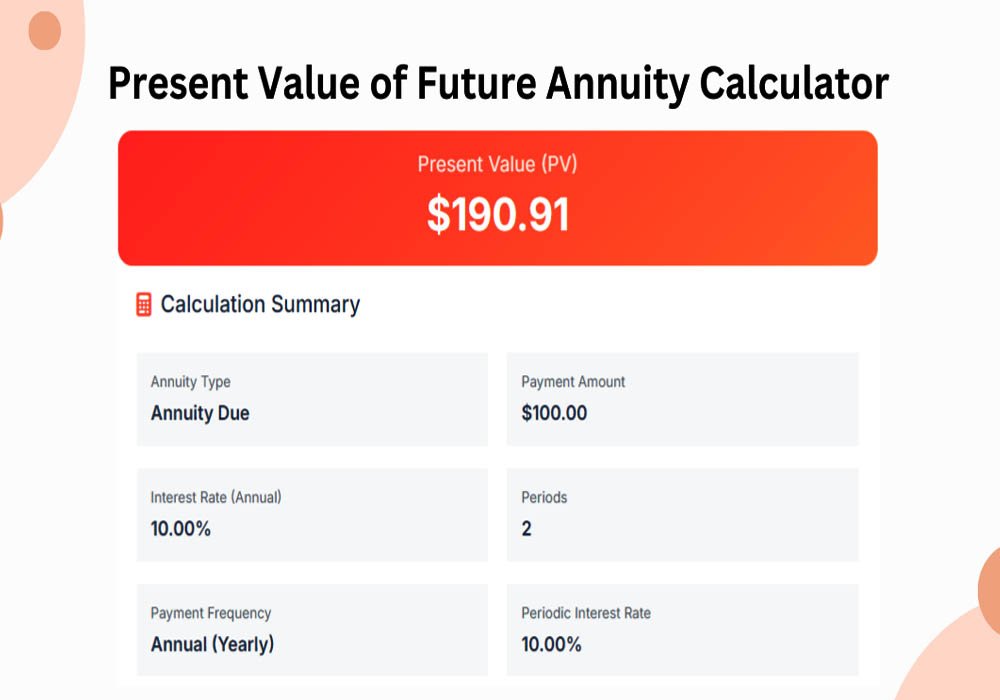
For an ordinary annuity, where equal payments are made at the end of each period, the future value can be estimated using the following formula:
FV = PMT × [(1 + r)ⁿ − 1] / r
Where:
- FV = future value of the annuity
- PMT = regular payment
- r = interest rate per period
- n = total number of payment periods
This formula helps show how regular contributions can accumulate when they earn interest over time. If payments are made monthly, the periodic rate and number of periods should also be based on monthly payments.
An actual annuity payout calculation can be more complicated because lifetime payments, immediate payments, variable returns, fees, and additional guarantees may require different calculations. An online calculator handles these calculations automatically and makes it easier to compare different assumptions.
How Much Does a $100,000 Annuity Pay Every Month?
A common question is, “How much does $100,000 annuity pay every month?” There is no universal answer because the monthly payment depends on the specific contract and payout structure. A lifetime annuity may provide a different payment than an annuity that guarantees income for a fixed number of years.
Age can also have an important effect. Someone purchasing lifetime income at a different age may receive a different monthly payment even if both people invest exactly $100,000. Survivor benefits, payment guarantees, fees, and other contract features can also affect the result.
An annuity calculator can help you compare these scenarios. Rather than relying on a general number, you can enter your investment amount and available assumptions to estimate potential monthly income and see how changing the payout structure affects the result.
Using an Annuity Calculator for Financial Planning
An annuity calculator is most useful when you compare several realistic scenarios instead of focusing on one projected number. For example, you could compare a $100,000 investment with $250,000 or $300,000 and examine how different payout periods affect monthly income. You can also compare fixed-period income with lifetime-income scenarios.
It is helpful to compare projected annuity income with your expected retirement expenses. If your monthly expenses are higher than your guaranteed income sources, an annuity may potentially cover part of the gap. However, retirement planning should also consider savings, investments, Social Security, pensions, taxes, healthcare costs, and inflation.
Before purchasing an annuity, review the contract’s fees, surrender charges, withdrawal restrictions, guarantees, beneficiary provisions, and other conditions. The calculated result is only an estimate based on assumptions, while the actual contract determines what you receive.
Frequently Asked Questions
There is no standard monthly payment for a $100,000 annuity. The amount depends on factors such as age, payout option, contract terms, fees, and whether payments are guaranteed for life or a fixed period. An annuity calculator can provide an estimate based on the assumptions you enter.
The retirement income from a $250,000 annuity depends on the type of annuity and selected payout option. Lifetime income, fixed-period payments, and survivor-benefit options can produce different results. A calculator can help compare potential monthly payments before considering an actual contract.
A $300,000 annuity does not have one fixed monthly payout. Your age, payout period, interest assumptions, contract features, and payment option can affect the result. An annuity payout calculator can help estimate potential income under different scenarios.
A $1 million annuity may generate substantial monthly income, but the exact payment depends on the specific contract. Lifetime payments, fixed-period payments, survivor benefits, fees, and other terms can affect the amount. Use an annuity calculator to compare different possibilities.
How is Social Security calculated?
An Annuity Calculator is an online tool that estimates the potential growth or income of an annuity. It can use inputs such as an initial investment, regular payment, interest rate, payment frequency, and time period to produce an estimate. It is useful for retirement and long-term financial planning.
Related Calculator:
Explore more financial tools designed to simplify your calculations. Whether you’re planning a mortgage, estimating an auto loan, calculating taxes, or tracking investment growth, our free calculators provide fast and accurate results to help you make smarter financial decisions.