
| # | Payment | Principal | Interest | Balance |
|---|
Repayment Calculator
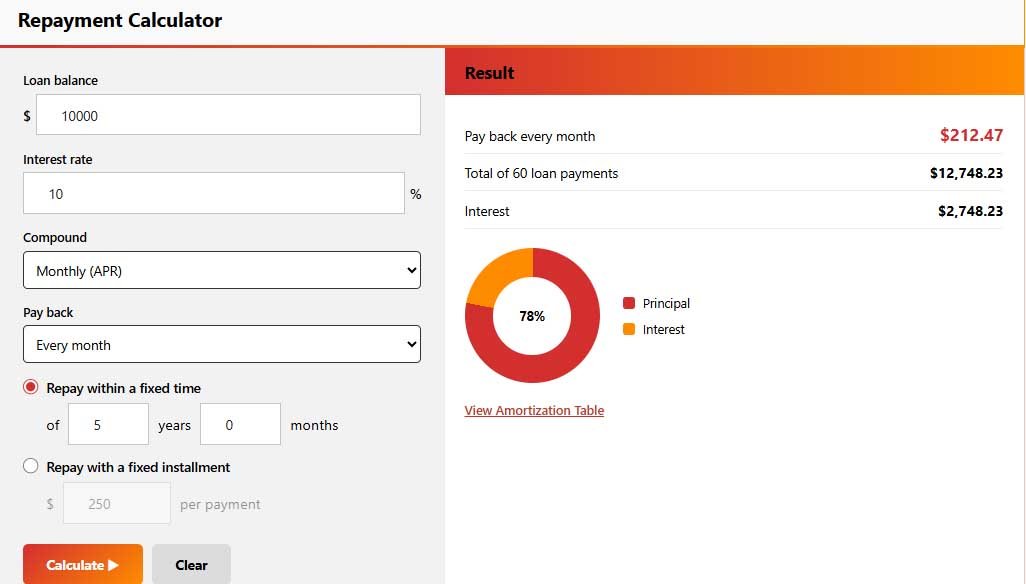
A Repayment Calculator helps you estimate how much you may need to pay each month toward a loan or credit balance and how long it could take to repay the debt. By entering the amount borrowed, interest rate, and repayment term, you can quickly compare different payment scenarios.
Whether you are financing a car, taking out a personal loan, managing student loans, or paying down a credit card balance, knowing your expected repayment amount can make budgeting easier. A calculator can also show how changes in the interest rate, loan term, or payment amount may affect the overall cost.
How Does a Roth IRA Calculator Work?
A Roth IRA growth calculator estimates the future value of your account using your current savings, regular contributions, expected annual return, and years until retirement.
A Simple Roth IRA Calculator can also help you quickly compare scenarios. For example, you can change your monthly contribution from $100 to $300 and see how the estimated balance may change over several decades.
The basic compound-growth formula is:
Future Value = Current Balance × (1 + Return Rate)ᵗ + Contributions
Your actual investment results can be higher or lower because investment returns are not guaranteed.
Early Loan Repayment Calculator
An Early Loan Repayment Calculator can help you understand what may happen if you pay a loan faster than originally scheduled. Making additional principal payments can potentially reduce the time you remain in debt and may lower the total interest paid.
For example, you could compare your regular monthly payment with a scenario where you make an additional $100 payment each month. The calculator can estimate how the extra amount could affect the remaining repayment period.
You can also consider occasional extra payments, such as using a bonus or other available funds toward your loan. However, check your lender’s terms first because some loans may have specific rules or potential prepayment penalties.
How Does a Repayment Calculator Work?
A Repayment Calculator Loan estimate is generally based on the principal balance, interest rate, and repayment period. For an installment loan, the calculator determines a regular payment that can cover both interest and principal over the selected term.
For example, borrowing $20,000 at a fixed interest rate for five years will produce a different monthly payment than borrowing the same amount for three years. A longer term may reduce the monthly payment, while a shorter term can increase the payment but potentially reduce the total interest paid.
A Monthly Loan Repayment Calculator is particularly useful when planning a budget because it lets you see the expected monthly obligation before committing to a loan. You can adjust the loan amount or term to find a repayment scenario that better fits your budget.
Repayment Formula
The standard installment-loan payment can be estimated using:
M = P × [r(1 + r)ⁿ] ÷ [(1 + r)ⁿ − 1]
Where:
M = monthly payment
P = principal loan amount
r = monthly interest rate
n = total number of monthly payments
The actual repayment amount can vary depending on lender fees, interest calculation methods, payment frequency, and the specific terms of the loan.
Repayment Calculator for Different Types of Debt
A Repayment Calculator Car can help you estimate the monthly cost of financing a vehicle. Enter the expected vehicle price or loan amount, interest rate, and loan term to see an estimated payment. You can also compare different down payments or repayment periods to understand how they affect the financing cost.
Car loans are often available with several repayment terms. Choosing a longer term may make monthly payments more manageable, but it can also increase the total amount of interest paid. Comparing terms before purchasing a vehicle can help you understand the long-term cost rather than focusing only on the monthly payment.
A Repayment Calculator Personal Loan works in a similar way. Personal loans may be used for expenses such as home improvements, major purchases, education, or debt consolidation. By entering the amount you plan to borrow and the expected interest rate, you can estimate your regular payment and total repayment cost.
For credit cards, the calculation can be different because credit cards are revolving accounts rather than fixed-term installment loans. A Repayment Calculator Credit Card can still help estimate how long it may take to eliminate a balance based on the outstanding amount, APR, and monthly payment.
Credit card interest can make repayment take longer when only minimum payments are made. Increasing your monthly payment may shorten the repayment period and reduce the amount of interest paid over time. Testing different payment amounts with a calculator can help you understand the potential effect before changing your repayment plan.
Student Loan Repayment Calculator
A Student Loan Repayment Calculator tool can help borrowers estimate payments based on their outstanding student loan balance, interest rate, and repayment period. Student loans can have different repayment plans and conditions, so the exact payment depends on the terms of the specific loan.
Borrowers can use a calculator to compare different payment amounts and understand how extending or shortening a repayment period may affect the overall cost. If you have multiple student loans, reviewing each balance and interest rate separately can provide a clearer picture of your total repayment obligations.
People may also search for a Repayment Calculator MOHELA when looking for information about student loan repayment associated with MOHELA. A general repayment calculator can help estimate loan payments, but it should not be considered an exact representation of an individual loan servicer’s statement. Always compare calculator estimates with your current loan information and official repayment terms.
What Affects Your Loan Repayment?
Several factors influence the amount you pay and the total cost of borrowing. Understanding these factors can help you use a repayment calculator more effectively.
- Loan amount: A larger principal generally results in a higher repayment amount.
- Interest rate: Higher rates generally increase the cost of borrowing.
- Loan term: A longer term can reduce monthly payments but may increase total interest.
- Payment frequency: Monthly, biweekly, or other payment schedules can affect the repayment timeline.
- Extra payments: Additional payments toward principal can potentially shorten the loan term.
- Fees: Origination fees and other charges can increase the overall cost.
- Existing balance: For credit cards and other revolving debt, the current balance affects interest and repayment time.
Because these factors work together, it is useful to test more than one scenario instead of relying on a single calculation.
How to Use a Repayment Calculator
Start by entering the amount you currently owe or the amount you plan to borrow. Next, enter the applicable interest rate and choose the repayment period. The calculator can then estimate the regular payment and, depending on the tool, the total interest and total repayment amount.
After getting your initial result, try changing one factor at a time. Increasing the monthly payment can show how quickly you could potentially repay the balance. Changing the loan term can show the difference between lower monthly payments and potentially higher total interest.
For an early repayment scenario, add an extra payment amount and compare the results. This can help you determine whether making additional payments could fit into your monthly budget.
The most accurate estimate comes from using current information from your lender or account statement. Interest rates, fees, and payment rules can differ between financial products.
Monthly Payments vs. Total Repayment Cost
When comparing loans, it is important not to look only at the monthly payment. A loan with a low monthly payment may have a longer repayment term, meaning you could pay interest for more years.
For example, extending a loan from five years to seven years may reduce the required monthly payment, but the longer repayment period can increase the total interest cost. A calculator allows you to compare both figures.
This is especially important when financing large purchases. Understanding the total amount you may repay can help you determine whether a loan fits your long-term budget.
Frequently Asked Questions
A Repayment Calculator estimates the amount you may need to pay toward a loan or debt. It can use your balance, interest rate, and repayment term to estimate monthly payments and total repayment costs.
It uses the loan amount, interest rate, and number of payments to estimate your regular payment. You can change the term or loan amount to compare different repayment scenarios.
Yes. Enter the vehicle loan amount, interest rate, and repayment term to estimate your monthly car payment. You can also compare different loan terms.
Yes. A personal loan repayment calculation can help estimate monthly payments and total interest based on the amount borrowed, rate, and repayment period.
It can estimate how additional payments may reduce the repayment period and potentially lower total interest. Actual savings depend on your loan terms and how your lender applies extra payments.
Related Calculator:
Explore more financial tools designed to simplify your calculations. Whether you’re planning a mortgage, estimating an auto loan, calculating taxes, or tracking investment growth, our free calculators provide fast and accurate results to help you make smarter financial decisions.