
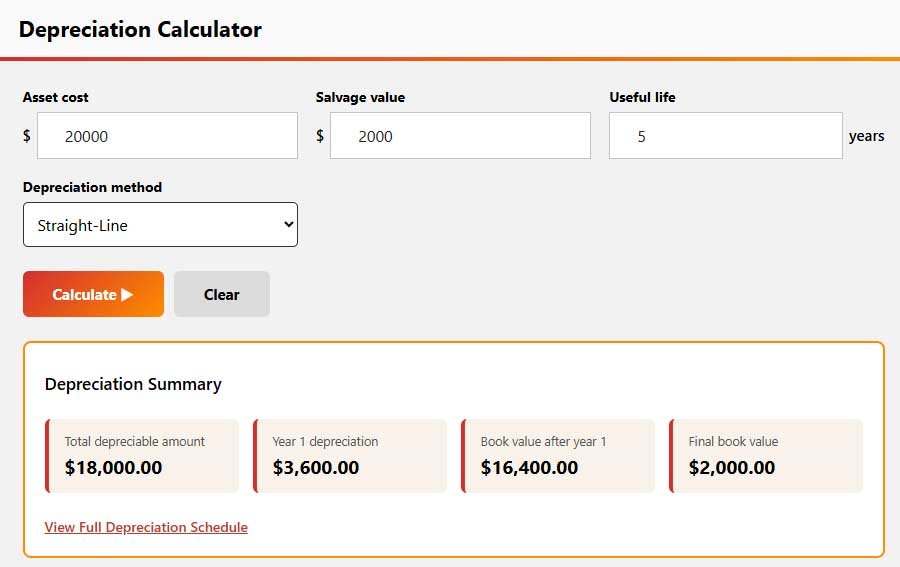
Depreciation Summary
| Year | Depreciation | Accumulated | Book Value |
|---|
Depreciation Calculator
A Depreciation Calculator helps you estimate how much an asset loses in value over time. Whether you are calculating depreciation for a car, house, equipment, furniture, or rental property, a calculator can make the process faster and easier. Depreciation is important for understanding an asset’s changing value and, in many cases, determining expenses or deductions for accounting and tax purposes.
Different assets depreciate in different ways. A vehicle may lose value because of age, mileage, condition, and market demand, while business equipment may depreciate based on its useful life and expected salvage value. Using the right inputs gives you a clearer estimate of annual depreciation and remaining value.
How Does a Depreciation Calculator Work?
A depreciation calculator generally requires information such as the original purchase price, salvage value, useful life, and sometimes the asset’s age or current value. The calculator then estimates how much value the asset loses over a specific period.
For example, if an asset costs $20,000, has a $2,000 salvage value, and has a useful life of 5 years, straight-line depreciation spreads the depreciable amount evenly across those years. The result can show the annual depreciation and estimated book value over time.
The exact calculation depends on the depreciation method being used. Straight-line depreciation is simple and consistent, while declining-balance methods generally recognize more depreciation during the earlier years.
Depreciation Calculator Formula
The depreciation calculator formula depends on the method selected. For straight-line depreciation, the basic formula is:
Annual Depreciation = (Cost of Asset − Salvage Value) ÷ Useful Life
Book Value = Cost of Asset − Accumulated Depreciation
This method spreads the depreciable cost evenly across the asset’s useful life. It is useful when you want a straightforward estimate of yearly depreciation.
Car Depreciation Calculator
A depreciation calculator for cars helps estimate how much a vehicle may lose in value as it gets older. Car depreciation can be influenced by the vehicle’s make, model, age, mileage, condition, and market demand.
A car depreciation estimate can be especially useful when deciding whether to buy a new or used vehicle. It can also help you estimate a vehicle’s potential resale value after several years of ownership. Some vehicle-focused calculators use current age, planned ownership period, annual mileage, make, and model to personalize depreciation estimates.
Unlike accounting depreciation, market depreciation for a car is not always perfectly linear. A vehicle can lose a larger portion of its value during certain periods and depreciate more slowly later.
Depreciation for Houses and Rental Property
A depreciation calculator house estimate can be useful when analyzing property-related costs, but real estate depreciation is different from the market value decline of a home. For tax purposes, the rules for depreciating property can depend on the type of property, how it is used, and applicable tax regulations.
A depreciation calculator for rental property can help landlords estimate depreciation-related amounts for investment analysis. Rental property depreciation is generally based on the depreciable portion of the property rather than simply assuming that the entire purchase price depreciates.
Because tax depreciation rules can be complex, calculator results should be treated as estimates rather than a substitute for professional tax advice.
Equipment and Furniture Depreciation
Businesses often need to estimate depreciation for assets such as machinery, computers, tools, office equipment, and furniture. A depreciation calculator for equipment can help estimate annual depreciation based on the equipment’s cost, useful life, and expected salvage value.
A depreciation calculator for furniture can similarly be used to estimate the loss in value of desks, chairs, cabinets, tables, and other furnishings. The useful life and depreciation method can vary depending on the asset and the accounting or tax rules that apply.
Common information needed for an asset depreciation calculation includes:
- Original purchase price
- Estimated salvage value
- Useful life
- Date the asset was placed in service
- Selected depreciation method
- Current age or accumulated depreciation
Tax Depreciation and IRS Rules
A tax depreciation calculator can help estimate depreciation for assets used in a business or income-producing activity. However, tax depreciation is not always the same as an asset’s actual market value decline.
The Depreciation Calculator IRS search intent is especially relevant for users who want to understand depreciation under U.S. tax rules. The IRS has specific requirements regarding depreciable property, recovery periods, depreciation methods, and when an asset is considered placed in service. The applicable rules can also vary based on the type and use of the property.
For this reason, a calculator can provide a useful starting estimate, but taxpayers should verify the applicable rules or consult a qualified tax professional before using depreciation figures on a tax return.
Straight-Line and Other Depreciation Methods
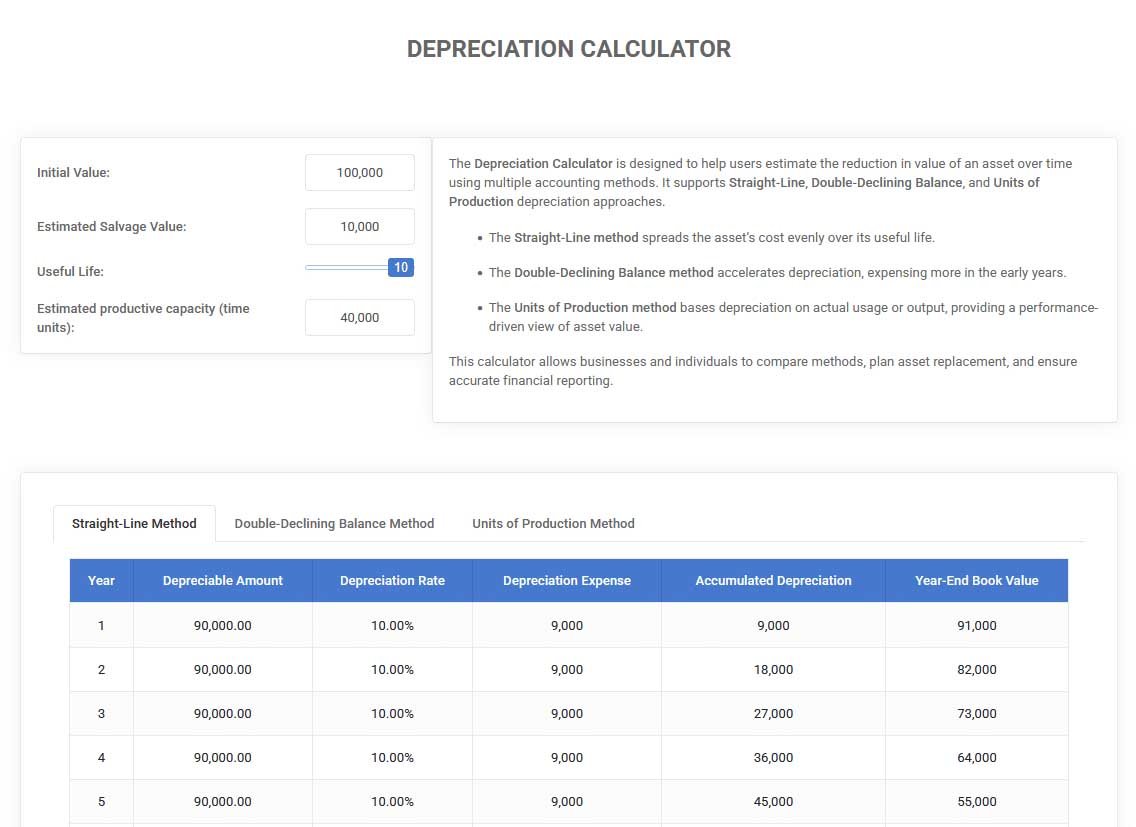
Straight-line depreciation divides the depreciable amount evenly across the asset’s useful life. It is one of the simplest methods and is useful when the asset is expected to provide relatively consistent value or benefit over time. Banzai’s asset depreciation calculator, for example, uses straight-line depreciation and asks for the purchase price, salvage value, and useful life.
Other depreciation methods may produce different results. Common approaches include declining balance, double-declining balance, units of production, and sum-of-the-years’-digits depreciation. The appropriate method depends on the purpose of the calculation and the applicable accounting or tax rules.
Benefits of Using a Depreciation Calculator
A depreciation calculator can make asset planning and financial analysis easier by providing a quick estimate instead of requiring manual calculations. It can be useful for individuals, businesses, property owners, and anyone evaluating an asset’s long-term cost.
Key benefits include:
- Estimate annual depreciation quickly.
- Calculate an asset’s remaining value.
- Compare different useful-life assumptions.
- Estimate depreciation for vehicles and equipment.
- Understand the effect of salvage value.
- Support business budgeting and financial planning.
- Get a starting point for tax-related depreciation research.
The result can also help you understand the difference between an asset’s original cost and its estimated value after several years.
Frequently Asked Questions
Depreciation is the reduction in an asset’s value over time. It can result from use, aging, wear and tear, obsolescence, or changes in market value.
Under the straight-line method, subtract the estimated salvage value from the asset’s original cost and divide the result by its useful life. This gives the estimated annual depreciation.
A car depreciation calculator is useful for estimating vehicle value based on factors such as age, mileage, make, model, ownership period, and expected resale value.
Yes, but rental property depreciation involves specific tax rules. A calculator can provide an estimate, while the actual tax treatment should be determined according to applicable regulations.
Yes. Enter the equipment’s purchase cost, estimated salvage value, useful life, and applicable depreciation method to estimate depreciation.
Related Calculator:
Explore more financial tools designed to simplify your calculations. Whether you’re planning a mortgage, estimating an auto loan, calculating taxes, or tracking investment growth, our free calculators provide fast and accurate results to help you make smarter financial decisions.